

Key takeaways
- Accelerating adoption: ETF assets held by North American institutional asset owners have nearly doubled in five years to $337 billion, growing at roughly triple the rate of the broader U.S. institutional market.
- Expanding use cases: Asset owners are moving beyond cash equitization, using ETFs as strategic core holdings, tactical adjustment tools, and public-market proxies for private assets.
- Deeper issuer partnerships: ETF providers are increasingly valued for education, research, analytics, and trading support—not just the fund itself.
For years, institutional investors treated ETFs largely as an operational tool for equitizing cash. That view is changing quickly. Asset owners across North America are broadening how they use the wrapper across core allocations, tactical positioning, and even co-manufactured exposures.
That was the central message of a recent webinar, Rethinking ETFs in Institutional Portfolios: How Asset Owners Are Broadening Use Cases, hosted by Institutional Investor. The discussion featured Garrett Glawe, CFA, Head of Asset Owner and Consultant ETF Specialists at Invesco, and Brendan Powers, CFA, Co-Head of Product Development and Institutional Practices at Cerulli Associates. The discussion drew on Invesco and Cerulli’s new joint research, Inside Institutional ETF Adoption: How asset owners are broadening use cases.
"There's been exponential growth in ETF use, and both users and non-users plan to increase their use moving forward."—Brendan Powers, Cerulli Associates
A market growing 3x the institutional average
At a time when the total pool of institutional assets is experiencing relatively tepid growth, ETFs stand out as an impressive outlier. Cerulli sized the North American institutional asset owner ETF market at approximately $337 billion, a figure the firm considers conservative given how difficult ETF ownership is to track. Assets have grown at a 14.4% five-year compound annual growth rate (CAGR), roughly three times the 5% CAGR of the broader U.S. institutional market. ETFs owned by endowments and foundations grew even faster, north of 32%.
CHART 1
Asset owner ETF usage is growing with no signs of slowing
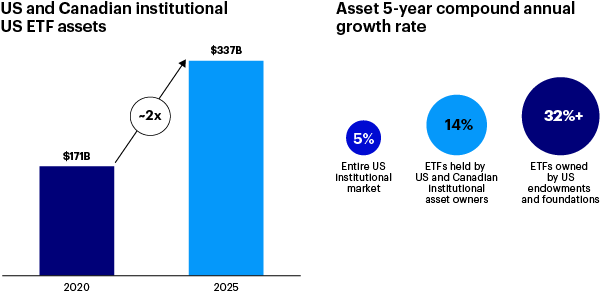

Public defined benefit plans remain the largest ETF holders at $134 billion, which makes sense given their large portfolios and sophisticated internal trading teams. However, foundations, endowments, and health and hospital systems have emerged as some of the fastest-growing ETF users among allocator segments.
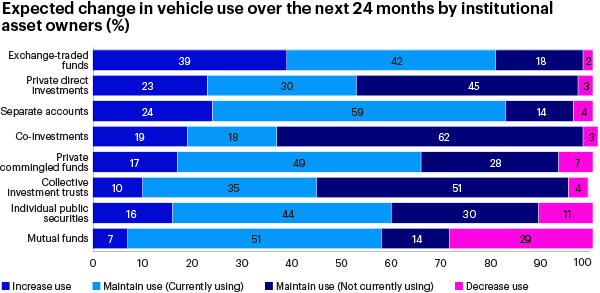
Forward-looking survey data indicates the growth in ETF usage shows no signs of slowing. Nearly 40% of asset owners plan to increase ETF exposure over the next two years, the highest net figure of any wrapper Cerulli tracks.
CHART 2
Expected change in vehicle use over the next 24 months by institutional asset owners
Use cases are broadening and increasingly innovative
The volume of usage isn’t the only shift in the market; how and why institutions are deploying ETFs have evolved dramatically, as well. Traditional applications such as cash equitization and transition management still matter, but institutions increasingly use ETFs for longer-horizon tactical and strategic objectives.
Invesco's review of ETF holdings among U.S. asset owners found the average holding period was about two and a half years, with some clients holding positions for five years or more. This reflects a marked shift from using ETFs as trading vehicles to core positions.
The webinar panelists shared several examples of how this new approach to ETF usage is playing out in institutional portfolios. Many asset owners are using the Invesco S&P 500 Equal Weight ETF (RSP) to address concentration concerns in the US equity market. One endowment dedicates a 5% sleeve of its portfolio to ETFs, adjusting a handful of positions inside that sleeve up and down to rebalance around illiquid private equity holdings. Others use Invesco's Senior Loan ETF (BKLN) as both a bank-loan exposure and a public-market proxy for private credit. A growing cohort is going further by partnering directly with issuers to co-create products. MERS of Michigan worked with Invesco to seed three Invesco S&P Quality, Value, and Momentum Multi-factor ETFs. They seeded these ETFs with $1 billion in 2021 and now have $1.9 billion invested in them as of 2025 year-end.
"If you put together a U.S. equity portfolio and there are certain exposures you want to adjust, ETFs can provide a very easy way to do that."—Garrett Glawe, Invesco
ETF providers have become indispensable partners
As institutional allocations to ETFs deepen, asset owners are asking more of their issuers. Fees, liquidity, tracking error, and assets under management still top the due diligence list, but provider brand and partnership resources are garnering increased attention during the fund selection and vetting process.
Cerulli’s Powers said the shift is most pronounced among leaner investment teams at institutions with $1 billion–$3 billion. This cohort increasingly leans on issuers for research, analytics, portfolio construction tools, and educational support. Glawe added that securities lending is another underappreciated benefit of owning ETFs; for a fund like BKLN, lending revenue may offset a meaningful portion of the expense ratio.
"Operational capacity can extend beyond simply the product to the service and support experience around the product."—Brendan Powers, Cerulli Associates
What it means for asset owners
The ETF wrapper is still a fast, cost-effective way to put capital to work. But the growth story is now about depth: larger allocations, longer holding periods, more customized exposures, and closer issuer partnerships.
Important Information
Not a Deposit; Not FDIC Insured; Not Guaranteed by the Bank; May Lose Value; Not Insured by any Federal Government Agency
All data as of 12/31/25 are sourced from Cerulli Associates and ISS Market Intelligence Simfund unless otherwise stated.
All investing involves risk, including the risk of loss.
Invesco is not affiliated with Cerulli Associates.
The opinions expressed are those of Garrett Glawe, CFA, and Brendan Powers, CFA, and are based on current market conditions and are subject to change without notice. These opinions may differ from those of other Invesco investment professionals.
Diversification does not guarantee a profit or eliminate the risk of loss.
This does not constitute a recommendation of any investment strategy or product for a particular investor. Investors should consult a financial professional before making any investment decisions.
Since ordinary brokerage commissions apply for each ETF buy and sell transaction, frequent trading activity may increase the cost of ETFs.
Factor investing is an investment strategy in which securities are chosen based on certain characteristics and attributes.
There are risks involved with investing in ETFs, including possible loss of money. Shares are not actively managed and are subject to risks similar to those of stocks, including those regarding short selling and margin maintenance requirements. Ordinary brokerage commissions apply. The Fund’s return may not match the return of the Underlying Index. The Fund is subject to certain other risks. Please see the current prospectus for more information regarding the risk associated with an investment in the Fund.
BKLN
Most senior loans are made to corporations with below investment-grade credit ratings and are subject to significant credit, valuation and liquidity risk. The value of the collateral securing a loan may not be sufficient to cover the amount owed, may be found invalid or may be used to pay other outstanding obligations of the borrower under applicable law. There is also the risk that the collateral may be difficult to liquidate, or that a majority of the collateral may be illiquid.
An issuer may be unable to meet interest and/or principal payments, thereby causing its instruments to decrease in value and lowering the issuer’s credit rating.
Interest rate risk refers to the risk that bond prices generally fall as interest rates rise and vice versa.
Non-investment grade securities may be subject to greater price volatility due to specific corporate developments, interest-rate sensitivity, negative perceptions of the market, adverse economic and competitive industry conditions and decreased market liquidity.
The risks of investing in securities of foreign issuers can include fluctuations in foreign currencies, political and economic instability, and foreign taxation issues.
The Fund is non-diversified and may experience greater volatility than a more diversified investment
Reinvestment risk is the risk that a bond’s cash flows (coupon income and principal repayment) will be reinvested at an interest rate below that on the original bond.
The Fund may engage in frequent trading of its portfolio securities in connection with the rebalancing or adjustment of the Underlying Index.
The Fund’s use of a representative sampling approach will result in its holding a smaller number of securities than are in the underlying Index, and may be subject to greater volatility.
The Fund may hold illiquid securities that it may be unable to sell at the preferred time or price and could lose its entire investment in such securities.
Under a participation in senior loans, the fund generally will have rights that are more limited than those of lenders or of persons who acquire a senior loan by assignment. In a participation, the fund assumes the credit risk of the lender selling the participation in addition to the credit risk of the borrower. In the event of the insolvency of the lender selling the participation, the fund may be treated as a general creditor of the lender and may not have a senior claim to the lender's interest in the senior loan. Certain participations in senior loans are illiquid and difficult to value.
The Fund currently intends to effect creations and redemptions principally for cash, rather than principally in-kind because of the nature of the Fund's investments. As such, investments in the Fund may be less tax efficient than investments in ETFs that create and redeem in-kind.
RSP
Investments focused in a particular industry or sector are subject to greater risk, and are more greatly impacted by market volatility, than more diversified investments.
Stocks of medium-sized companies tend to be more vulnerable to adverse developments, may be more volatile, and may be illiquid or restricted as to resale.
Invesco Distributors, Inc.
NA 5799137