

Diversification matters more than ever, yet in our view, it has become increasingly difficult to achieve. The environment that quietly did much of the work for portfolios over the past decade has changed. Interest rates once again carry a price, the stock-bond correlation can no longer be assumed to be negative, and equity indices have become increasingly concentrated in a narrow set of growth exposures. Each of these shifts increases the value of independent return streams; taken together, they make the scarcity of true diversification a first-order portfolio construction problem.
Indeed, many institutional portfolios may hold fewer genuinely distinct sources of return than their allocation maps suggest. Growth and rates can explain a large share of return variation across asset classes, managers, and mandates, which means a portfolio may span dozens of positions across public and private markets while still being driven by a relatively small number of underlying (economic) factors. Diversification across holdings does not necessarily translate into diversification across return drivers.
What becomes scarce in such an environment is true orthogonality: return streams whose economic engines are meaningfully distinct from the growth and rates exposures already held. Portable alpha provides a deliberate framework to access those return streams, rather than hoping they emerge as a by-product of adding incremental mandates.
The missing diversifier: six principles of portable alpha
1. Start with the drivers, not the labels. The natural starting point is to decompose an existing portfolio into its underlying risk drivers rather than its asset-class classifications. Seen through this lens, exposures that appear quite different on paper, such as global equities, credit, and parts of the hedge fund and private-market universe, can in practice respond to many of the same economic forces. Adding another allocation with similar sensitivities to the existing exposures may broaden the portfolio without materially diversifying it.
2. Separate beta from alpha. Traditional mandates generally bundle two decisions together: which market exposure to own and which manager should attempt to outperform it. Portable alpha separates these choices by first determining which beta exposures belong in the strategic portfolio and how efficiently that exposure can likely be maintained, and only then identifying the sources of excess return. Once those decisions are treated separately, capital no longer needs to be tied up in obtaining beta simply to access alpha, creating greater flexibility to select return sources for the independence of their underlying drivers.
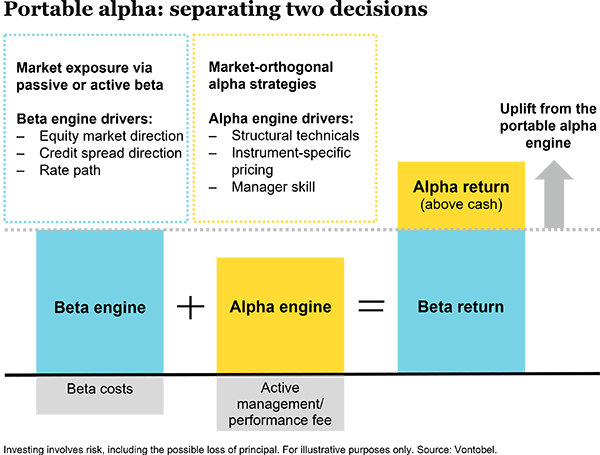

3. Judge alpha by what drives it. Not every source of return improves diversification, which is why, in our view, the relevant question is not what a strategy is called, but what investors are ultimately being compensated for. In fixed income, for example, contractual carry, structural premia created by market segmentation, and idiosyncratic relative value opportunities can each provide distinct sources of return because they are earned for different economic reasons. Their value therefore lies not simply in their return potential, but also in the fact that the underlying engines are usually distinct enough to be combined and, potentially, ported onto different betas without simply adding more of the risks already present in the portfolio.
4. Evidence should span more than one regime. The quality of the evidence matters. Backtests alone are not enough; the more useful test, in our view, is how the underlying return sources behaved across different market environments. For example, a composite of three fixed-income strategies combining the sources of alpha described above would have generated between 470 and 850 basis points of excess return above cash over a 105-month track record from 2017 to 2026, depending on liquidity tolerance and the allocation to idiosyncratic relative value. The period matters as much as the number because it spans several distinct episodes of market stress, including 2022, when both equities and bonds repriced sharply at the same time and dependence on the traditional growth-and-rates mix became particularly visible.
5. The trade-off should be explicit. Portable alpha is not a tail-risk hedge. When applied to equity or balanced portfolios, the objective is to improve full-cycle returns by introducing return sources that may continue to compound independently of the beta exposure. That benefit, however, may come with somewhat deeper drawdowns in acute stress periods, particularly where leverage is used to maintain the underlying beta. Its contribution may therefore be more apparent over the path of a cycle than at the precise point of maximum market stress, especially in recovery periods when the beta remains below its previous peak, but the independent return sources continue to add to the portfolio.
6. The case for separating alpha and beta is not new, but today’s environment makes it more relevant. Interest rates matter again, stock-bond diversification is less dependable, concentration within major indices has increased, and finding differentiated alpha sources within traditional allocations has become more difficult. None of this makes portable alpha universally appropriate, but it does make the underlying portfolio construction question harder to ignore.
For each additional allocation, investors can ask whether the next unit of risk introduces a genuinely new return driver or simply adds more exposure to the ones already owned in size. Where the answer is the latter, the portfolio may become more complicated without becoming meaningfully more diversified. Portable alpha reframes the architecture around that distinction: hold beta efficiently and treat orthogonality as something to be acquired deliberately.
To learn more, download the full report.
1Based on a live track record. Source: Vontobel
Author

Ola Mahmoud, PhD, Head of Vontobel Solutions
Content provided for educational purposes only. The information provided does not constitute investment advice and should not be relied on as such. It should not be considered a solicitation to buy or an offer to sell any security. There is no assurance that the investment method and objective referenced will be achieved. Investing involve risk, including the possible loss of principal. There is no representation or warranty as to the current accuracy, reliability, or completeness of, nor liability for, decisions based on such information.