
At the heart of Aspect Capital's recent Insight Series paper Rethinking Diversification: Bonds, Commodities and Trend in the Current Market Regime is a simple proposition: If the world is moving from an era of abundant energy and the free movement of labour and capital to one characterized by supply constraints and geopolitical friction, investors may need to rethink their dependence on bonds as the primary source of portfolio diversification.
The paper argues that investors should reconsider whether traditional fixed income can remain the cornerstone defensive allocation when inflation, policy uncertainty, and supply-side shocks play a larger role in markets.
The resulting perspective is timely for institutional investors reconsidering how diversification works across bonds, commodities, and trend-following strategies. Rather than treating macro change as an abstract backdrop, the analysis focuses on what a shift toward a more constrained and contested regime could mean for capital allocation, asset-class roles, and the search for diversifying sources of return.
The Diversification Question Moves to the Center of Portfolio Construction
The paper argues that the global system underpinning much of the past few decades’ growth may be reaching its limits. That system was built on efficiency, deep interdependence, and assumed security and neutrality across supply chains, reserve assets, and energy flows. Rising frictions may point toward a more constrained, fragile, and strategically contested regime.
For institutional investors, the implication is straightforward: A new regime may require a fresh look at the role each asset class plays in building resilient and genuinely diversified portfolios.
Why Bonds May Be a Less Reliable Shock Absorber

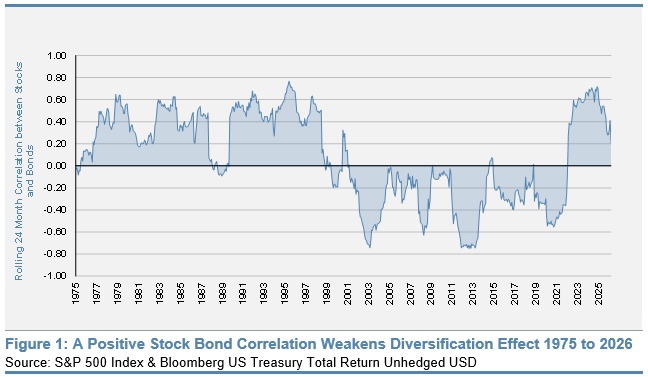
The most direct portfolio construction challenge concerns fixed income. In a regime defined by exogenous shocks, bonds may struggle to diversify equity risk in the way they did during the past 25 years. In such environments, correlations between equities and fixed income tend to turn positive because of persistent inflation risks, weakening the defensive role of bond allocations in multi-asset portfolios.
The inflation shock of 2021 to 2022 is presented as a recent example of this dynamic. Figure 1, titled “A Positive Stock Bond Correlation Weakens Diversification Effect,” shows the rolling 24-month correlation between stocks and bonds from 1975 to 2026, using the S&P 500 Index and Bloomberg US Treasury Total Return Unhedged USD as its source data.
The challenge may be compounded by elevated debt burdens among major sovereign debt issuers, including the United States, United Kingdom, and France.
The result is a diminished role for traditional bonds, which may become increasingly exposed to some of the same forces driving equity risk, namely inflation volatility and policy uncertainty.
Stores of Value Are Being Reassessed
A second theme is the changing role of reserve assets and stores of value. The appeal of Western fixed income markets has been undermined by geopolitical developments in recent years. The confiscation of Russian reserves by Western governments sent a message to sovereign investors that financial assets are not politically neutral and can be weaponised.
Within that context, assets with no counterparty risk, most notably gold, have re-emerged as strategic stores of value as central banks reassess how to diversify traditional reserve assets.
Figures 2 and 3 develop the point. Figure 2, “Central Banks Diversify into Gold,” shows quarterly global gold purchases by central banks and other institutions from 2008 to 2026, using Macrobond and World Gold Council as sources. Figure 3, “New Forces Drive the Price of Gold,” shows spot gold and the inverted 10-year US real yield from 2009 to 2026, using Macrobond, the US Department of Treasury, and LBMA as sources.
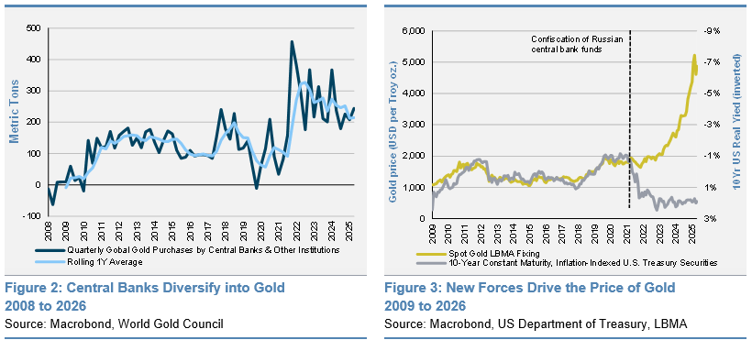
As central bank buying accelerated, gold’s performance, became less tied to real rates and more influenced by sustained demand from official sector buyers.
Commodities Shift from Cyclical Exposure to Strategic Allocation
The third portfolio construction theme is the re-emergence of commodities as strategic assets. The wars in Ukraine and Iran have displayed the vulnerability of economies to energy crises, while reliable access to energy remains critical to economic activity.
Countries are turning back toward cheap and reliable sources of energy to address the threat of higher prices. Germany, for instance, is considering firing up idle coal plants again to alleviate rising energy costs caused by the war in Iran. In Italy, Prime Minister Giorgia Meloni has called for an immediate suspension of the EU’s emissions trading system to help reduce costs for energy producers and lower energy prices.
The closure of the Strait of Hormuz highlighted that resource vulnerability extends beyond energy, disrupting fertiliser exports and industrial inputs ranging from aluminium to specialised gases used in semiconductor production.
From an investment perspective, commodities may no longer be viewed predominantly as a play on the economic cycle. In a regime potentially shaped by supply-side shocks, commodities can offer diversification when bonds struggle, provide protection against structurally higher inflation, and investors get exposure to geopolitical fragmentation, resource scarcity, and technological competition.
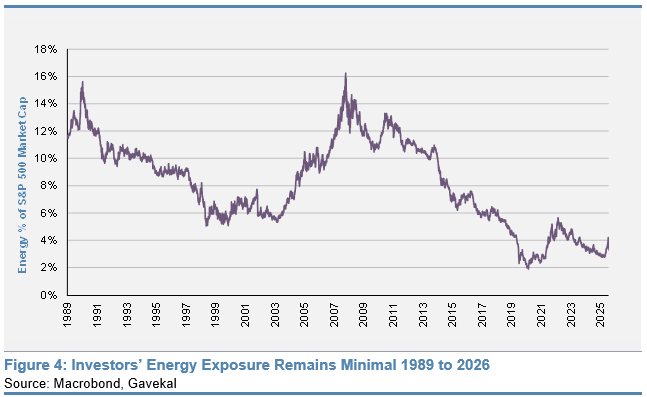
Figure 4 reinforces the point by showing that current energy sector exposure through a passive S&P 500 allocation is near historical lows, based on energy as a percentage of S&P 500 market capitalisation from 1989 to 2026.
Where Trend Following Fits
Another avenue sits within liquid alternatives: trend-following strategies run by Commodity Trading Advisors. These strategies have historically provided diversification from equity market risk across numerous market regimes, particularly during inflationary and stagflationary episodes.
First, CTAs can provide systematic and liquid exposure to commodities through futures markets, with dynamically managed long and short positions rather than passive commodity exposure. Second, their long/short structure can capture trends from rising and falling prices across asset classes, reducing reliance on a single macro regime. Third, systematic trend-following strategies are designed to capture sustained trends that may emerge during significant macro regime shifts. Fourth, by operating across equities, fixed income, currencies, and commodities, CTAs may be positioned to exploit relative and absolute price movements when cross-asset correlations break down.
For investors focused on portfolio construction, that framework is the central practical contribution. A changed backdrop requires different diversification tools, including commodities and adaptive, cross-asset trend-following strategies.
Building for Resilience Rather Than Relying on Past Relationships
The reassessment of globalisation, trade integration, abundant energy, and free movement of labour and capital may mark more than a cyclical adjustment. It may point to a structural shift in the macro and market regime in which portfolios must operate.
In that setting, diversification frameworks that worked during the era of global disinflation can no longer be taken for granted.
For institutional investors, the implication is clear: Diversification may need to move beyond traditional stock-and-bond assumptions and place greater emphasis on commodities, and trend-following strategies.
Note: Any opinions expressed are subject to change and should not be interpreted as investment advice or a recommendation.