

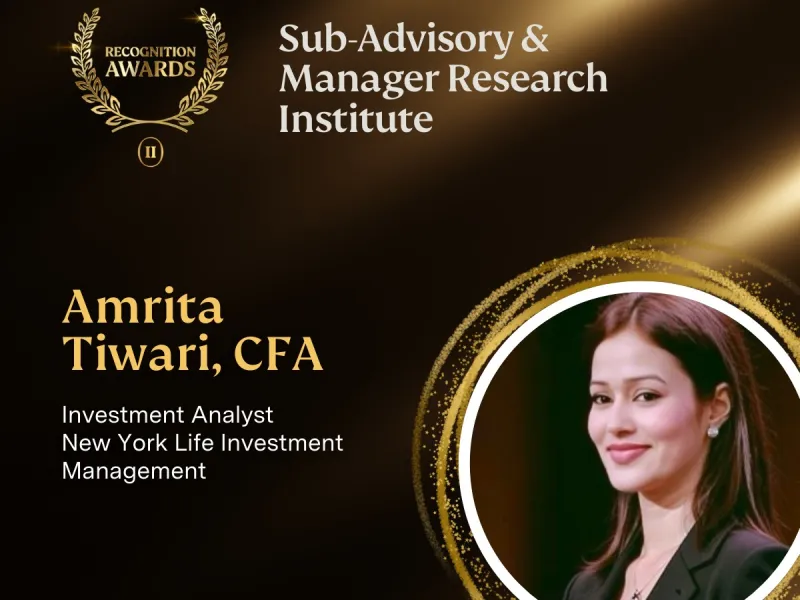
The Sub-Advisory Institute is recognizing 15 Next Gen and Industry Visionary Award Winners of the sub-advisory and manager research space this year for their leadership, innovation, and active participation in the investment industry. David Braham, Senior Executive Director, Thought Leadership & Market Intelligence at Institutional Investor, sat down with Next Gen Award Winner Amrita Tiwari, CFA, Investment Analyst, New York Life Investment Management.
Amrita has built her career around creating meaningful outcomes that extend beyond her role through thoughtful leadership. Born and raised in Nepal, Amrita developed an early curiosity about how systems operate and how individual decisions can ripple through broader economies. Growing up in a developing- market environment gave her firsthand exposure to the real-world impact of financial structures, resource constraints, and economic change.
She later moved to the United States as a student, motivated by a desire to step beyond familiar boundaries and immerse herself in a truly global and competitive setting. The transition strengthened her adaptability and broadened her perspective, allowing her to engage with new academic disciplines, cultures, and financial frameworks. Navigating this shift deepened her appreciation for the interconnected nature of global markets and the value of diverse viewpoints in financial decision-making.
Amrita’s interest in finance evolved from a strong foundation in quantitative thinking and analytical problem-solving. Drawn to data-driven work, she gravitated toward identifying patterns, modeling uncertainty, and breaking down complex problems in fast-moving market environments. Her interest in the interplay between quantitative analysis and human behavior shaped her path toward trading, market structure, and research roles that require thoughtful decision-making and the ability to adjust in real time.
In the conversation, Amrita reflected on how technology shows up in her everyday life, her commitment to helping others grow, and the importance of maintaining a long-term, human perspective in both personal and professional decisions.
The following is edited for length and clarity.
 What does being recognized as a Next-Gen Industry Visionary mean to you, both personally and professionally?

This recognition is incredibly meaningful to me, both personally and professionally. On a personal level, it’s affirming to reflect on the journey and the moments of uncertainty, learning, and growth that shaped how I show up today. It’s a reminder that curiosity, persistence, and staying open to new ways of thinking truly matter.
Professionally, I see this recognition as motivation to continue contributing thoughtfully and to help shape what the next generation of leadership looks like. I am especially passionate about influencing and inspiring women earlier in their careers, helping them feel confident speaking up, taking ownership, and pursuing paths that may initially feel intimidating. If my experience can help make that path feel more accessible or encourage someone to see what’s possible, then this recognition carries even greater meaning.
As you look back at 2025, what was the event that most surprised you and impacted your year?
Looking back at 2025, what surprised me most was how quickly AI became part of my everyday work and how much it changed the way I approach problem-solving and learning. I expected it to be a useful tool, but I didn’t anticipate how deeply it would influence workflow, decision-making, and even how I think through complex problems.
Adapting to this shift pushed me outside my comfort zone and required me to be more curious, flexible, and intentional about upskilling. The experience had a real impact on my year because it reinforced the importance of continuous learning and being open to change, especially in an environment where technology evolves faster than any single role or process.
What are you most excited about, personally or professionally?
I am most excited about how AI is becoming meaningfully integrated into both everyday life and more complex professional work. AI and tools like ChatGPT have quietly woven themselves into almost every part of daily life. From planning Spring Break travel, to organizing birthday parties for my two girls, Myra and Sahara, it has become an invaluable tool for managing everyday life and simplifying countless small decisions. What is especially striking is how seamlessly this technology has moved beyond convenience-driven tasks into areas of far greater complexity and consequence.
Looking ahead, it is fascinating to think about how AI could transform fields where decisions carry real consequences, from healthcare and life sciences to capital allocation and investment management. Will it meaningfully enhance research, decision-making, and outcomes? As AI continues to evolve, the more important question becomes how we strike the right balance, ensuring that human judgment, creativity, and critical thinking remain central rather than becoming overly dependent on the technology designed to support them.
What type of leader do you want to be, and what skills do you want the people above you to have to make you better leaders?
The kind of leader I strive to be is one who brings clarity and creates space for others to contribute. I take ownership to reduce noise, connect ideas, and translate complexity into clear strategy. Most importantly, I want people to feel comfortable speaking up, even when they are unsure. I make a conscious effort to support early-career professionals by sharing my own experiences, acknowledging uncertainty, and reinforcing that it is okay to ask questions or challenge ideas. Creating psychological safety in fast-paced or intimidating environments is something I take seriously.
From the leaders above me, I value transparency, trust, and strong mentorship. I am most effective when they set clear expectations, encourage open dialogue, and lead with humility, qualities that shape how I would show up for my own team.
What made you want to work in the investment sector?
What drew me to the investment sector was the opportunity to apply my quantitative skills in a field with tangible, real-world impact. Financial markets influence almost everyone’s life through savings, retirement, and long-term financial security – and that breadth of impact immediately stood out to me. Although there are many meaningful paths, such as medicine or scientific research, investment management felt uniquely compelling because decisions made in the markets directly shape people’s financial futures.
As we look at 2026, what’s the one thing you want to achieve next year, and what’s the one thing you think is going to happen?
As I look ahead to 2026, the one thing I am certain about is continued uncertainty. The pace of change feels constant, and I expect the year to be defined by adapting thoughtfully rather than reacting instinctively.
On a personal level, I want to be more intentional about making time to read, especially physical books instead of relying only on audio. That said, when I think about it, I do end up reading quite a bit, just not always what I originally had in mind. My older daughter is currently obsessed with Harry Potter and similar series, while my younger one is fully in her Bluey phase. Between the two of them, my reading list looks very different these days, but it’s still time well spent.
Who do you want to have dinner with this year?
I would love to have dinner with Oprah. Her journey, from overcoming adversity to building a platform with lasting influence, is deeply inspiring.
Market Intelligence is independent of the Institutional Investor Magazine Newsroom.